Last Updated Date: September 22, 2026
Author: Nina Crawford
Source: Canada Revenue Agency (CRA) Official Announcement
CRA Enhances Online Tax Filing Security: New 2026 Multi-Factor Authentication Rules Explained
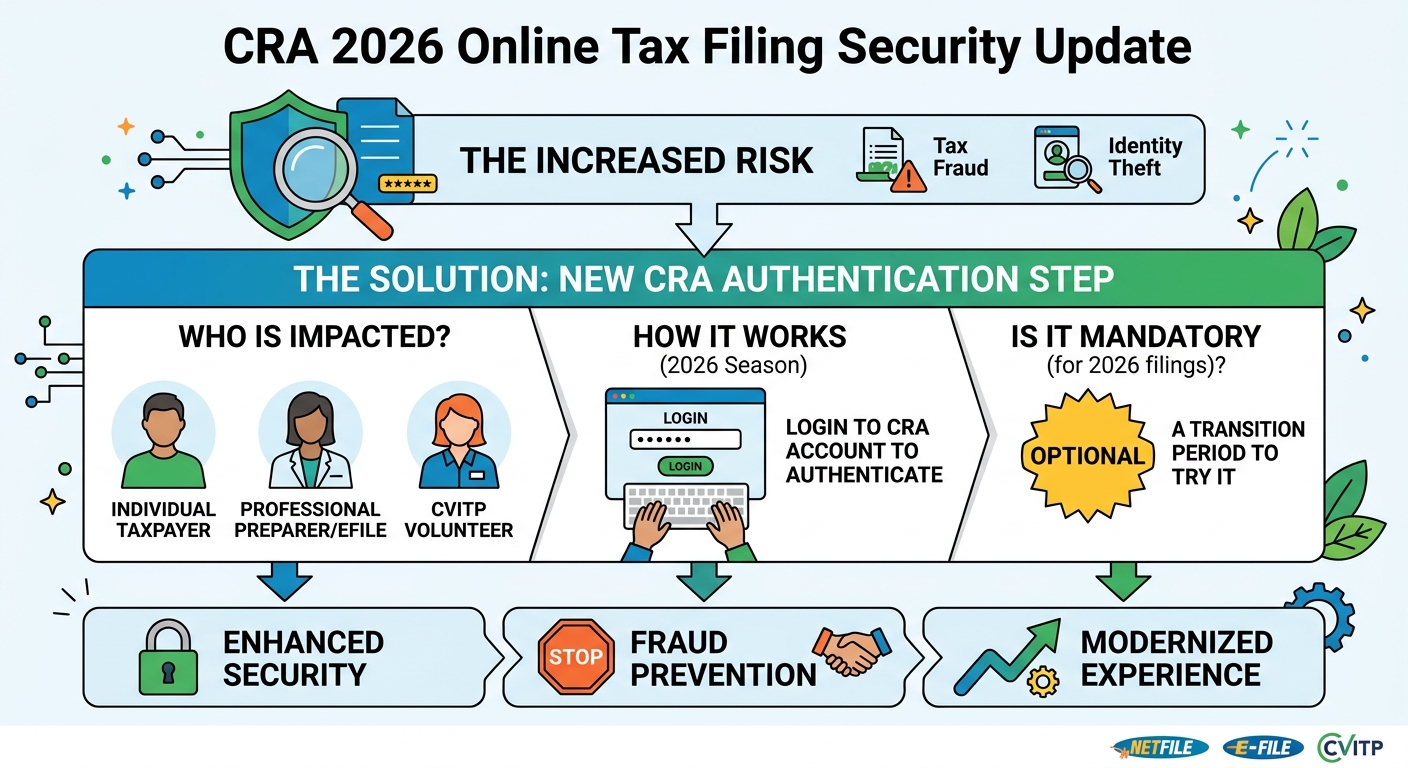
Starting February 22, 2027, for the 2026 tax filing season, the Canada Revenue Agency (CRA) is introducing an enhanced online authentication security step for individuals, tax preparers, and authorized representatives filing personal income tax and benefit returns.
Designed to combat tax fraud, identity theft, and unauthorized refilings, this new security workflow links tax software submissions directly to verified CRA user accounts. Understanding how these changes impact NETFILE, EFILE, and Community Volunteer Income Tax Program (CVITP) operations is critical for a smooth 2026 tax season.
Key Takeaways of the 2026 CRA Security Update
- Effective Launch Date: February 22, 2027 (covering the 2026 tax filing year).
- Optional Pilot Phase: For the 2026 tax return filing period, the authentication step is optional to allow filers to familiarize themselves with the workflow.
- Core Function: Authenticates the filer’s identity via their official CRA online account login prior to transmitting data via NETFILE or EFILE.
- Fraud Mitigation: Prevents unauthorized tax modifications, identity spoofing, and fraudulent refund claims.
- Account Readiness: Users with locked, suspended, or restricted CRA accounts must resolve issues before attempting electronic tax filing.
How the New CRA Security Step Works Across Filer Roles
The implementation of the CRA authentication verification varies depending on whether you are filing your own taxes, filing as a tax professional, or volunteering.
| User Role | Filing Method | Authentication Mechanism | Requirements & Restrictions |
|---|---|---|---|
| Individual Taxpayers | NETFILE | Sign in to personal CRA My Account | Confirms identity; links submission to the return owner. |
| Authorized Representatives | NETFILE | Sign in to representative CRA My Account | Must possess valid prior client authorization on file with CRA. |
| First-Time Filers | NETFILE | Exempt from personal account authentication | Can file via NETFILE without a CRA account; representative can authenticate on their behalf. |
| Tax Preparers / EFILE | EFILE | Sign in to practitioner CRA account | Verifies the identity of the person initiating filing; valid for entire active session. |
| CVITP Volunteers | EFILE | Sign in to volunteer CRA account | Follows standard EFILE session verification rules. |
Detailed Breakdown for Individuals and Authorized Representatives
When filing a 2026 tax return via NETFILE-certified tax software, users will encounter a prompt to authenticate by logging into their CRA account.
- Self-Filers: Authenticating verifies that you are submitting a tax return or adjustment for yourself, adding an extra cryptographic layer of protection to your financial records.
- Authorized Representatives: Representatives must ensure their authorization status is up-to-date in the CRA database prior to filing. The system verifies that the logged-in representative holds explicit legal permission to submit or adjust returns for the specific taxpayer.
- First-Time Tax Filers: Taxpayers with no prior tax history in Canada lack an existing CRA account. First-time filers are exempt from account sign-in requirements and can submit returns directly through NETFILE. Alternatively, an authorized tax representative can complete the authentication step on their behalf.
Detailed Breakdown for Tax Preparers and EFILE Users
For professional accountants, tax preparers, and Community Volunteer Income Tax Program (CVITP) volunteers using EFILE software, the workflow offers session-based efficiency:
- Identity Verification: The login authenticates the specific individual initiating the electronic filing transmission. Unlike NETFILE, EFILE authentication verifies the preparer’s credentials rather than requiring individual client authorization for every batch transmission.
- Session Persistence: Once a tax preparer or volunteer successfully signs in to their CRA account, the session remains active. You can continue submitting multiple client returns under EFILE without re-authenticating until the software session expires or is closed.
Steps to Prepare Your CRA Account Before Filing Season
To prevent filing delays when the tax season opens on February 22, 2027, taxpayers and preparers should execute the following account audit:
1. Resolve Account Locks and Restrictions
If your CRA My Account or EFILE account is locked, restricted, or suspended, resolve these issues immediately. The CRA provides online self-service recovery options to regain access without requiring telephone support.
2. Configure Multi-Factor Authentication (MFA)
Ensure robust Multi-Factor Authentication is established. Set up a secondary backup MFA method (such as an authenticator app or backup phone number) to prevent lockouts if your primary verification device is unavailable.
3. Audit Personal and Client Information
Verify that your mailing address, direct deposit details, marital status, and representative permissions are current in the CRA database prior to initiating software filing.
Frequently Asked Questions (FAQ)
Is the new CRA authentication step mandatory for 2026 returns?
No. For the 2026 tax filing season (starting February 22, 2027), completing the sign-in authentication step is optional. The CRA has introduced it as a transition period so Canadians and tax professionals can adjust to the new workflow.
What happens if my CRA account is locked when I try to file?
You will not be able to complete optional authentication if your account is locked or restricted. While you can bypass authentication during the optional 2026 filing period, you should use CRA’s online self-service recovery tools to restore access to avoid future filing disruptions.
Can first-time filers use the new authentication system?
First-time tax filers do not have a pre-existing CRA account and cannot complete the personal authentication step. They remain fully eligible to file tax returns electronically via NETFILE without logging in.
Do EFILE preparers need client CRA account access to file returns?
No. EFILE users and CVITP volunteers sign in to their own CRA credentials to verify their identity as the transmitter. They do not log into their clients’ personal CRA My Accounts.
Additional Read: CPP & OAS application wait time
Suggested Reading: Canada’s FREE Dental Care Plan
Passport Canada Question: How to speak to a Passport Canada agent quickly